

京都仙洞御所Kyoto Sento Imperial Palace and Kyoto Omiya Imperial Palace
京都大宮御所御車寄Okurumayose
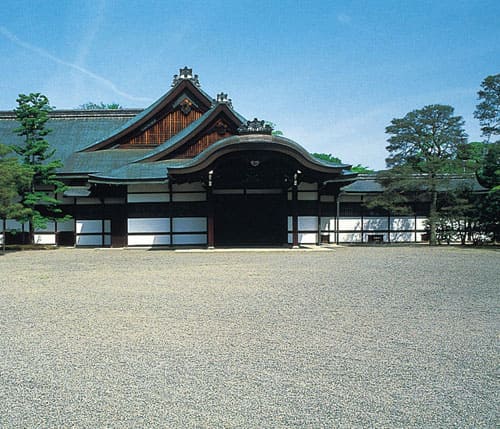
大宮御所の玄関であり,現在も天皇皇后両陛下や上皇上皇后両陛下が入洛された際に使用されている。
This is the entrance to the Kyoto Omiya Imperial Palace.
京都大宮御所御常御殿と南庭Otsunegoten
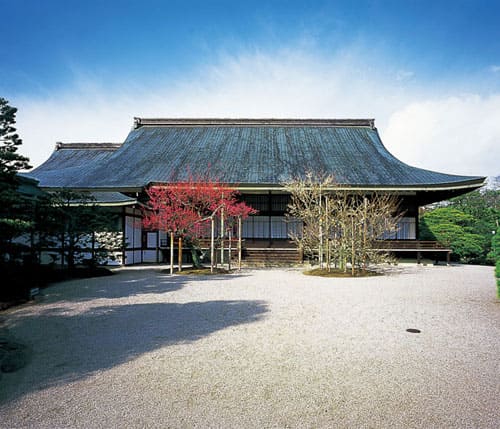
大正年間に内部を洋風に改め,周りにガラス戸をはめている。庭には紅梅・白梅,竹林,松が植樹され,「松竹梅の庭」とも伝えられている。
This is where Empress Dowager Eisho actually lived. The interior of the residence was remodeled in a Western style to receive His Royal Highness the Prince of Wales (later King Edward VIII ) of the United Kingdom on the occasion of his State visit to Japan in 1922. Today, their Majesties the Emperor and Empress and their Imperial Highnesses the Crown Prince and the Crown Princess stay at this Palace during royal visits.
北池とその周辺North Pond

京都仙洞御所の池は,紅葉谷の掘割を境にして北池と南池とに二分される。大宮御所御常御殿の南庭から土塀の潜り戸を抜けると一望に見渡せる雄大な眺望が北池の全景である。造営当初は女院御所の庭であった。池の東に寄せた中島は西から見る景色に奥行きを与え,対岸の樹木の上に遙か紫に霞む東山の峰が借景として採られている。右回りに池を巡ると,北池との境に六枚橋が架かる古びた入江の阿古瀬淵があり,その北の小高い丘の上には紀貫之の邸宅跡を示す石碑が立っている。明治8年(1875年)の建立である。ゆるやかな汀線に沿って東へ進むと右手に北池をへだてて紅葉山が,左手の上堤上には鎮守社の朱色の垣が見えかくれする。その向こうはかつては水田であったが,今は菖蒲園となっている。中島は鷺島とも呼ばれ,それに架かる土橋,石橋と渡って行くと鷺の森とも呼ばれている樹木の茂みがある。その中を縫って行くと掘割にかかる紅葉橋と呼ばれている土橋へと至る。もはや北池は見えず,南池の世界が展開する。
Upon leaving the Kyoto Omiya Imperial Palace from the side gate of the south garden, the entire view of the North Pond comes into sight. The islet, situated to the east of the pond, adds a depth of perspective to the view as seen from the west, In addition, the top of Higashiyama Mountains, tinted a misty violet hue, can be seen above the trees on the opposite side of the pond, and blends in with the rest of the natural landscape as the surrounding scenery.
又新亭Yushintei
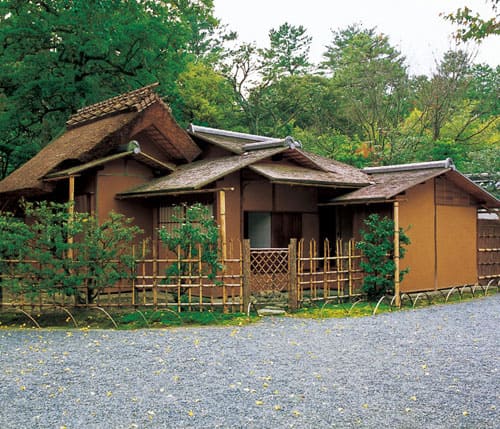
明治17年(1884年)に近衛家から献上された茶室である。もともとこの場所には,修学院離宮から移築した茶室止々斎があったが,火災により焼失した。茅葺と柿葺の屋根と大きな丸窓を備えた茶室で,中門により内露地と外露地に隔てられ,四つ目垣で囲むことにより結界を設けている。ここだけは侘茶の小天地を形づくっているようである。亭の門外に外腰掛があり,紅葉山裾野の蘇鉄山と相対している。
This is a teahouse that was a gift presented by the Konoe family in 1884. It has a large round window and a thatch and shingle roof. The teahouse appears to lie in a world of its own, with the tea garden divided by an inner gate, and a trellis separating the tea garden from the Sento Imperial Palace garden. In the tea garden there is a seat with an arbor on the outer side of the inner gate.
阿古瀬淵Akosegafuchi
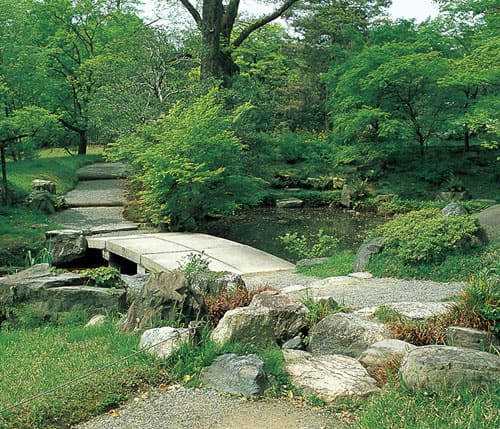
紀貫之の幼名「阿古久曽」に由来する。
It is said that one of the most famous poets of the Heian period (794-1191), Kino Tsurayuki (ca.868-945), lived in this area. The name of this pool originates from Kino's childhood name, " Akokuso". A monument to Kino's memory lies on the bank located at the other side of the stone bridge.
紅葉橋Momijibashi
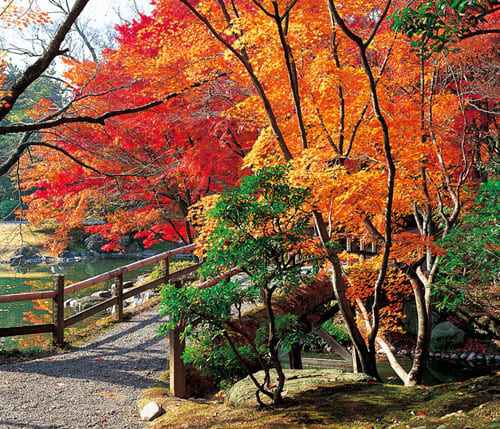
This is a bridge that spans the canal that connects the North Pond and South Pond. In autumn, the maple trees are a riot of dazzling autumnal colors.
南池とその周辺South Pond
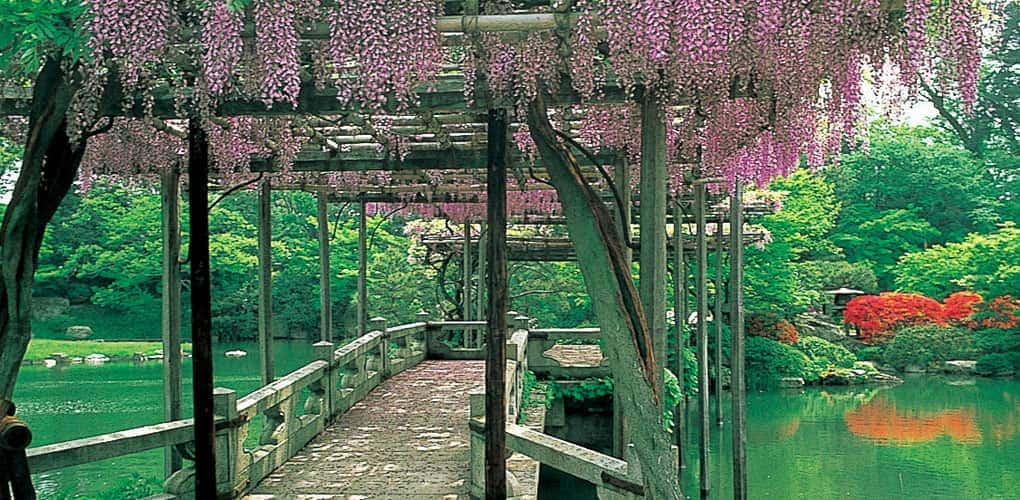
南池の中程に二つの中島がある。中島の一つに西岸から藤棚に覆われた八ツ橋が架けられ,中島と中島を短い石橋でつなぎ,東岸にかけて反橋が渡されるなど,趣向の異なる橋が渡れるように工夫されている。反橋を渡ったところには,かつて滝殿,釣殿,鑑水亭などの建物があった。また,紅葉山の下あたりには,とうとうと布落ちする幅80cm,高さ180cmの雄滝,その右手には自然石と切り石を組んだ出島の護岸が見事に眺められる。雄滝に近く,出島西岸の根元に突き出た三畳敷きほどもある大きい平石は「草紙洗の石」と呼ばれ,小野小町と大伴黒主のエピソードがある。さらに南を見れば池の向こうに醒花亭の佇まいが木の間ごしに望まれる。八ツ橋を渡り,葭島を右に見ながら南池東岸を南下し,南岸から西岸一帯の洲浜にそって苑路は北上する。洲浜には楕円形のやや平たい粒の揃った11万1千個ほどの石を池の中まで緩やかに敷き詰めてある。その石一個につき米一升の約束で運ばせたと伝えられ,「一升石」の別名もある。玉石を敷き詰めた洲浜は京都御所にもあるが,柔らかな広がりを感じさせる点で,ここに勝るものはない。洲浜の西に万葉歌人柿本人麻呂を祀った小社がある。
There are two islets in the South Pond, offering a clear geometric contrast that results from the differing forms of the monument, bridges, trees, boulders and the teahouse. The bridge, yatsuhashi (zigzag bridge) is covered with a fujidana (wisteria trellis) and it extends from the west shore to the islet. There is a stone bridge connecting the two islets and there is an arched bridge leading to the east shore. These different styles of bridges also contribute to the visual contrast. There is a waterfall near the bottom of Momijiyama, or Maple Hillock.
醒花亭Seikatei
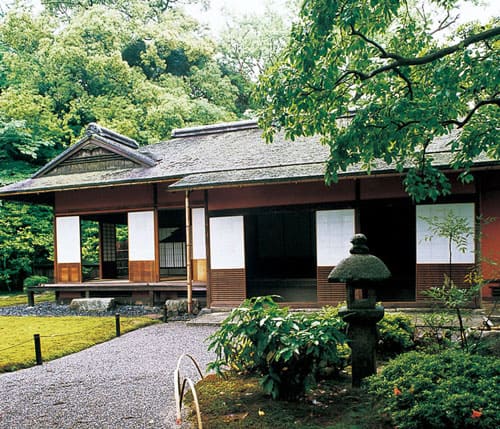
庭園の最も南の位置に北面している茶亭である。南池を一望する格好の場所にあり,今はない止々斎,鑑水亭とともに回遊式庭園における三店の一つである。正面の玄関には廂を付け出し,腰高障子を入れ,その右(東側)は奥に四畳半の書院,手前に五畳の入側(縁側)を取り,書院と入側の境に建具を入れないところが特異である。
This is a teahouse that is located in a north-facing position in the southernmost part of the garden, from which one can enjoy the entire view of the South Pond. The name originates from a poem by well-known Chinese poet Li Bo (701-762).
醒花亭内部と庭Inside of the Seikatei and Garden
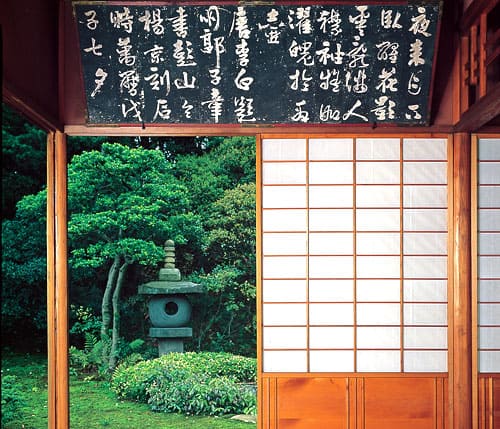
醒花亭の「醒花」は李白の詩から取られたもので,入側の東,鴨居の上に拓本の額として掲げられている。額の字は中国明の時代の郭子章の筆である。この建物は煎茶でいう三店式(酒店,飯店,茶店)ともいい,いずれの場合でも利用できるように造られている。東の庭には「ふくろう」の銘のある手水鉢を据え,飛石を配し,銭型の蹲踞(茶庭の手水鉢)と,加藤清正の献上品と言われている朝鮮灯籠が植え込みによく調和している。
Li Bo's poem is written on the tablet. The characters in the frame are ones by Guo Zi-zhang of Ming dynasty China. The eastern garden has hand-washing basins and Korean lanterns that bear the signature "owl".
醒花亭から洲浜,南池を臨むLooking to the South Pond and Shoreline from the Seikatei
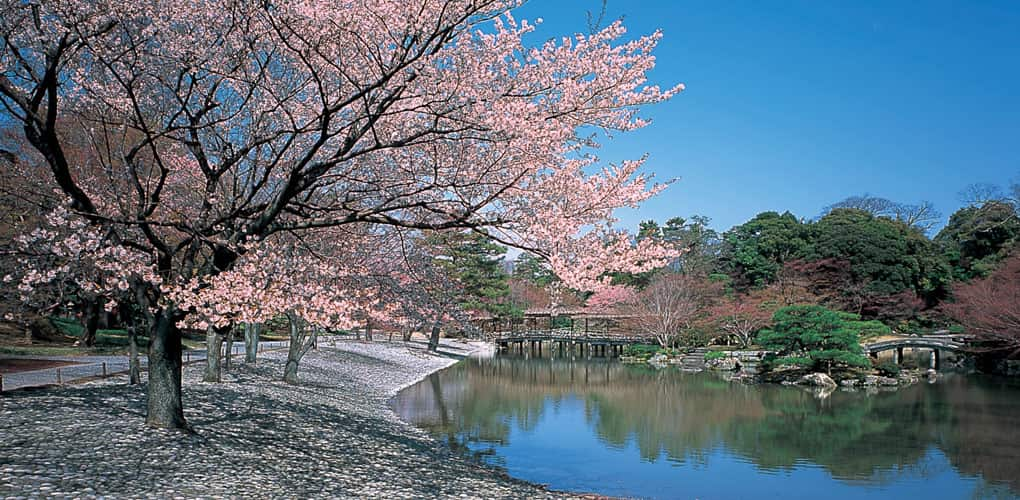
洲浜に沿って直線に広い道がある。この道は桜の馬場と呼ばれ,廷享4年(1747年)に桜町上皇が歌人冷泉為村に選ばせた仙洞十景の一つに「醒花亭の桜」として挙げられている。当時の仙洞十景は,寿山の早苗,古池の山吹,茅葺の時雨,神祠の夜燈,滝殿の紅葉,釣殿の飛螢,鑑水の夕照,悠然台の月,醒花亭の桜,止々斎の雪である。
There are 111,000 rather flat and oval stones that are laid out from the shoreline into the pond. It is said that each stone was transported for one sho (about 0.5U.S. gallons) of rice. To the west of the shoreline is a small shrine dedicated to poet Kakinomotono Hitomaro, many of whose works can be found in the famous poetry anthology the Manyoshu (Ten Thousand Leaves), compiled in the 8th century. The view from the Seikatei looking to the South Pond is one of the most renowned spots in all of the Sento Imperial Palace grounds, as it becomes gloriously abloom with cherry blossoms in spring.